
How Underride Collisions Cause Catastrophic Brain Injuries
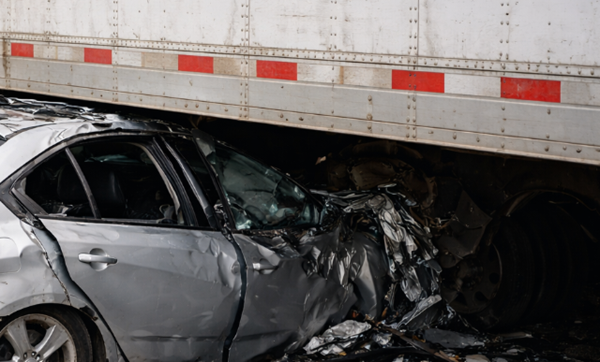
Most people understand that colliding with a tractor-trailer is dangerous. What many don't fully grasp is that the geometry of certain truck crashes can bypass every safety system in a modern vehicle. This often sends the trailer edge directly into the occupant space at head height. The result is a category of brain injury so severe that survivors are rare, and those who do survive face lifetimes of medical care.
March is Brain Injury Awareness Month, a time to shine a light on the causes and consequences of traumatic brain injuries that too often go unexamined. Underride collisions are among the most under-discussed hazards on American roads. Understanding how they happen, and what they do to the human brain, matters for families trying to make sense of what went wrong and why.
What is an underride collision, and why are cars so vulnerable?
An underride crash happens when a smaller vehicle slides beneath the body of a larger truck, rather than colliding with it at bumper-to-bumper level. This can happen:
- From the rear, when a car runs into the back of a trailer.
- From the side, when a truck makes a wide turn and a vehicle crashes underneath the trailer's edge.
The problem is that every safety feature in a passenger car is engineered to absorb and redirect energy from impacts that happen at bumper height. A trailer edge entering at windshield or roofline height is a completely different threat.
Federal rules have required rear underride guards on trailers since 1998. These metal bars hang from the back of trailers to stop cars from sliding underneath. But safety researchers and the Insurance Institute for Highway Safety say many guards buckle or fail during real-world crashes. Side underride guards may help prevent the most lethal type of underride. However, they're not federally required in the United States, unlike in Canada and parts of Europe. That regulatory gap has cost lives.
Why does this type of crash cause such devastating brain injuries?
The physics are brutal and straightforward. When a trailer edge enters a passenger compartment at roofline height, it makes direct contact with the occupants' heads, bypassing the vehicle roof that would ordinarily protect them. The roof is not involved in absorbing the impact the way it would be in a rollover. There is simply nothing between the occupant and the trailer structure.
Key catastrophic head and brain injuries include:
- Brain contusions (bruising of brain tissue), including coup, contrecoup, and coup‑contrecoup contusions from the brain striking the inside of the skull at one or multiple sites.
- Diffuse axonal injury (widespread shearing of nerve fibers) from the violent deceleration forces, often leading to coma or severe permanent disability.
- Skull fractures (linear, depressed, or basilar) that may be accompanied by brain bleeding, cerebrospinal fluid leaks, and infection risk.
- Intracranial hemorrhages and hematomas (epidural, subdural, intracerebral), which can rapidly increase pressure inside the skull and be fatal without emergency surgery.
- Penetrating brain injuries, when metal, glass, or crushed vehicle structures break the skull and enter the brain.
- Secondary brain injuries, such as swelling, herniation, hypoxia (lack of oxygen), and ischemia (lack of blood flow) that worsen the initial trauma and can be fatal or permanently disabling.
What are the long-term consequences for survivors?
Surviving a catastrophic brain injury from an underride collision is not the same as recovering from one. Long-term outcomes depend on the severity and location of brain damage, but severe TBI survivors commonly face:
- Vegetative or minimally conscious states requiring round-the-clock nursing care
- Cognitive deficits, including profound memory loss, inability to plan or sequence tasks, and severe attention impairment
- Personality and behavioral changes, including aggression, emotional dysregulation, and impulse control disorders
- Post-traumatic epilepsy, which can develop months or even years after the injury
- Motor dysfunction, spasticity, and chronic pain
- Loss of the ability to work, drive, or live independently
The financial cost of lifetime care for a severe TBI survivor can reach into the millions. Life care planners, who are often called as expert witnesses in truck accident litigation, help document these projections so that compensation reflects the actual scope of what has been lost, not just immediate medical bills.
Who bears legal responsibility after an underride crash?
Liability in underride cases rarely falls on just one party. Multiple individuals and organizations may share responsibility depending on the circumstances of the crash. Potentially liable parties include:
- The trucking company, if the driver failed to signal a turn, if the trailer's guard was defective or improperly maintained, or if the company's broader safety culture contributed to the crash.
- The truck or trailer manufacturer, if an underride guard failed under conditions it should have been able to withstand. This can open the door to product liability claims.
- Cargo companies and logistics firms, depending on how the crash unfolded and their role in the chain of events.
Evidence that helps prove liability in these cases includes:
- The truck's event data recorder, which captures speed and braking inputs in the moments before impact.
- Electronic logging data, which can reveal whether the driver was fatigued.
- Post-crash inspection reports documenting whether the underride guard performed as required.
Pajcic & Pajcic helps crash victims demand accountability
An underride accident can change your life for years after the crash. Medical bills pile up while you're still trying to understand what happened. Insurance adjusters call with offers that sound reasonable until you realize they don't come close to covering what you've actually lost.
Pajcic & Pajcic has spent decades standing between trucking companies and the people they've hurt, and we know exactly what these cases require to win. Our experienced truck accident attorneys search for compelling evidence, challenge the narratives insurance companies use, and fight to recover the full compensation you're owed.
When trucking companies and their insurers try to minimize what happened, real cases tell a different story. One of our most significant results involved a catastrophic underride collision with a log truck.
In that case, a log truck attempted a U-turn in low-light conditions on U.S. 1, blocking the roadway. The passenger vehicle struck the trailer and rode underneath it, allowing debris and structural elements to intrude directly into the occupant space. The impact caused a traumatic brain injury that permanently changed the course of a young woman’s life.
While she can appear outwardly normal, she lives with lasting neurological damage that affects her mobility, judgment, and ability to live independently. The jury recognized the full scope of that harm, awarding $13 million in compensation, including damages for long-term care and loss of quality of life.
That case reflects what underride crashes often look like in the real world. The injuries are not temporary setbacks. They are life-altering events that require ongoing care, support, and accountability. If you or a loved one was seriously injured in an underride accident, contact us today to book a free, no-obligation consultation.
"A great law firm that truly goes the extra mile for their clients. I was in an accident(rear-ended) last year with neck and shoulder injuries, and they made sure I was compensated extremely fairly. This is not a one-and-done firm; they fought and rejected multiple offers from the insurance company until my fair settlement was met. Thank you very much, Pajcic and Pajcic." - K.D., ⭐⭐⭐⭐⭐